


How do grooved pipe fittings connect to other pipe components?
As a seasoned supplier of grooved pipe fittings, I've had the privilege of witnessing the versatility and efficiency of these remarkable components in a multitude of piping systems. Grooved pipe fittings have revolutionized the way pipes are connected, offering a faster, more reliable, and cost - effective alternative to traditional welding and threading methods. In this blog, I'll delve into the details of how grooved pipe fittings connect to other pipe components, exploring the different types of connections and their benefits.
Understanding Grooved Pipe Fittings
Grooved pipe fittings are designed with a grooved end that allows for a secure and flexible connection to other pipes or fittings. The groove is typically machined onto the end of the pipe or fitting, creating a uniform channel around the circumference. Two main types of grooves are commonly used in the industry: the standard groove and the Victaulic - style groove. The standard groove is a basic design that provides a simple and effective connection, while the Victaulic - style groove is a more advanced design that offers enhanced sealing and strength.
Types of Connections
1. Couplings
Couplings are the most common type of grooved pipe fitting, used to connect two pipes together. The Grooved Threaded Reducing Coupling is a prime example. It can join pipes of different diameters, allowing for a seamless transition in the piping system. To connect two pipes using a coupling, the first step is to ensure that the pipes are cut to the appropriate length and the grooves are clean and free of debris. The coupling is then placed over the ends of the two pipes, and the bolts are tightened evenly. As the bolts are tightened, the coupling compresses the gasket between the two pipes, creating a watertight seal.
2. Tees
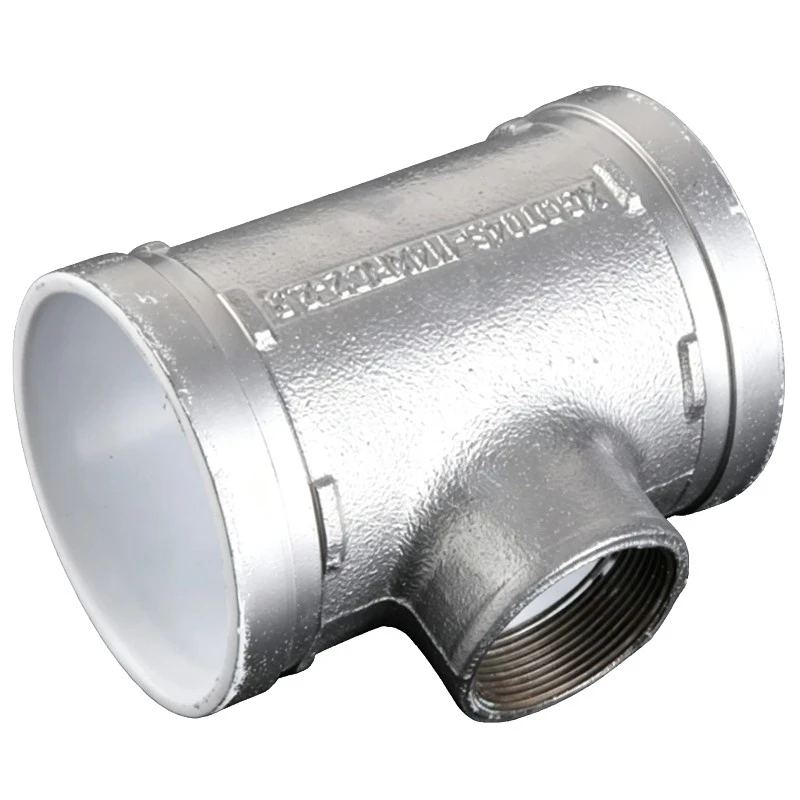
Tees are used to branch off a main pipe into two or more additional pipes. The Lined Grooved Reducing Tee and Lined Grooved Threaded Unequal Tee are popular choices in various applications. When connecting a tee to other pipe components, the same principle of groove alignment and gasket compression applies. The tee is first positioned at the desired location in the piping system, and the pipes are then inserted into the appropriate ports of the tee. The coupling around the connection is tightened, ensuring that the gasket creates a proper seal. This allows for smooth flow distribution within the piping network.
3. Elbows
Elbows are used to change the direction of the pipe. A Lined Grooved 45 Degree Elbow is essential in situations where a gradual change in direction is required. The installation process of an elbow is similar to that of a coupling. The elbow is aligned with the groove of the pipe, and a coupling is used to secure the connection. The gasket within the coupling ensures that there is no leakage at the joint, even when the fluid or gas is flowing under pressure.
4. Flange Adapters
Flange adapters, such as the Grooved Flange Adapter, are used to connect grooved pipes to flanged components, such as valves or pumps. The grooved end of the adapter is connected to the grooved pipe using a coupling, while the flanged end is bolted to the flanged component. This type of connection allows for easy installation and removal of the flanged component without disturbing the rest of the piping system. The gasket between the flange and the flanged component must be properly installed to prevent leakage.
Benefits of Grooved Connections
One of the primary benefits of using grooved pipe fittings is the speed of installation. Compared to welding, which requires skilled labor and lengthy preparation and cleanup times, grooved connections can be made quickly with simple hand tools. This significantly reduces installation time and labor costs.
Another advantage is the flexibility of grooved connections. Unlike welded joints, which are rigid, grooved connections can accommodate some movement and vibration in the piping system. This makes them ideal for use in applications where the pipes may be subject to thermal expansion, contraction, or seismic activity.
Grooved connections also offer excellent sealing performance. The compression of the gasket between the grooved components creates a tight, watertight seal that prevents leaks and ensures the integrity of the piping system. Additionally, the ease of disassembly and reassembly of grooved connections makes maintenance and repairs much simpler.
Quality Assurance in Grooved Pipe Fittings
As a supplier, I understand the importance of quality in grooved pipe fittings. All our fittings are manufactured to strict industry standards, using high - quality materials. We conduct rigorous testing on our products, including pressure testing and dimensional inspections, to ensure that they meet or exceed the requirements of our customers. Our commitment to quality means that our customers can rely on our grooved pipe fittings for long - term, reliable performance in their piping systems.
Conclusion
Grooved pipe fittings offer a reliable, efficient, and cost - effective solution for connecting pipes and other components in a wide range of applications. Whether you're working on a small plumbing project or a large industrial installation, the versatility and ease of use of grooved connections make them an ideal choice. If you're in the market for high - quality grooved pipe fittings, I encourage you to reach out to us for a detailed discussion about your specific needs. We're here to provide you with the best products and solutions to meet your piping requirements. Contact us today to start the procurement process and let us help you build a robust and efficient piping system.
References

- "Piping Handbook" by Mohinder L. Nayyar
- Industry Standards for Grooved Pipe Fittings published by relevant engineering associations


